

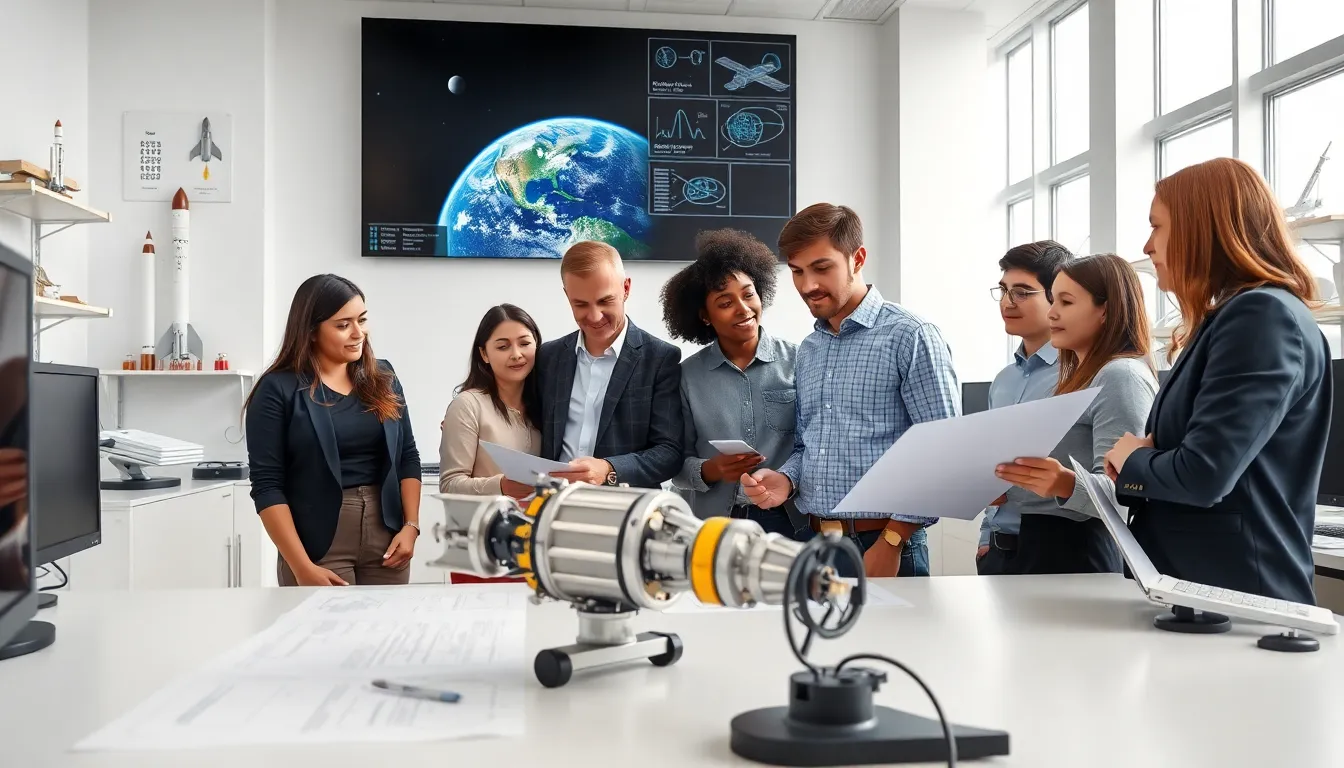
Space technology shapes how people communicate, explore, and understand the universe. From the satellites that power GPS navigation to the rockets that carry astronauts beyond Earth’s atmosphere, space tech touches daily life in surprising ways. But how does someone actually learn about space technology, or even break into this field?
This guide explains what space technology is, the main types that exist today, how engineers and scientists develop these systems, and practical steps for anyone interested in pursuing a career in space tech. Whether someone wants to build satellites, design spacecraft, or simply understand the science behind rocket launches, this overview provides a solid starting point.
Table of Contents
ToggleKey Takeaways
- Space technology encompasses satellites, rockets, spacecraft, and ground-based systems used for communication, observation, and exploration.
- Over 7,500 active satellites currently orbit Earth, powering everything from GPS navigation to weather forecasting and internet connectivity.
- Developing space technology follows a rigorous process including concept, design, testing, and operation phases that can span years or decades.
- Degrees in aerospace engineering, mechanical engineering, electrical engineering, physics, or computer science provide the best foundation for technical roles in space tech.
- Hands-on experience through internships, university CubeSat programs, and rocketry competitions significantly boosts career prospects in this growing industry.
- Non-engineering professionals like project managers, technical writers, and policy analysts also play essential roles in the space technology field.
What Is Space Technology?
Space technology refers to any equipment, system, or method used to explore space or operate within it. This includes rockets, satellites, space stations, probes, and the ground-based systems that support them.
At its core, space technology serves three main purposes: communication, observation, and exploration. Communication satellites relay phone calls, internet data, and television signals across the globe. Observation satellites monitor weather patterns, track environmental changes, and support military surveillance. Exploration vehicles, like rovers and crewed spacecraft, help scientists study other planets, moons, and asteroids.
Space technology also extends to the tools used on Earth to support missions. Mission control centers, launch facilities, and tracking stations all qualify as space tech infrastructure. Even the software that calculates orbital trajectories counts as part of this field.
The definition keeps expanding as private companies join government agencies in developing new systems. What started as a Cold War competition has become a global industry worth over $450 billion annually.
Key Types of Space Technology
Space technology falls into several categories. Each type serves different functions and requires specialized engineering.
Satellites and Communication Systems
Satellites represent the most common form of space technology. Over 7,500 active satellites currently orbit Earth, handling everything from weather forecasting to streaming video.
Communication satellites sit in geostationary orbit about 35,786 kilometers above Earth. They stay fixed relative to the ground, which makes them ideal for broadcasting signals to specific regions. Lower-orbit satellites, like those in SpaceX’s Starlink constellation, circle the planet faster and provide internet coverage to remote areas.
Earth observation satellites capture images and data about the planet’s surface, atmosphere, and oceans. Governments use them for mapping, disaster response, and climate research. GPS satellites form a network that enables precise location tracking for billions of devices.
Space technology in satellite form requires advanced components: solar panels for power, antennas for transmission, thrusters for position adjustments, and radiation-hardened electronics that can survive the harsh conditions of orbit.
Spacecraft and Exploration Vehicles
Spacecraft carry humans or instruments beyond Earth’s atmosphere. Crewed vehicles like NASA’s Orion capsule and SpaceX’s Dragon transport astronauts to the International Space Station and beyond.
Uncrewed probes travel much farther. The Voyager spacecraft launched in 1977 and continues to send data from interstellar space. Mars rovers like Perseverance conduct experiments on the Martian surface, searching for signs of ancient life.
Rockets provide the thrust needed to escape Earth’s gravity. Modern rockets use liquid or solid propellants, sometimes both. Reusable rockets, pioneered by SpaceX’s Falcon 9, have dramatically reduced launch costs by landing boosters for future flights.
Space stations serve as orbital laboratories where astronauts conduct research impossible on Earth. The International Space Station has hosted continuous human presence since 2000.
How Space Technology Is Developed
Developing space technology follows a rigorous process. Most projects move through distinct phases: concept, design, testing, and operation.
The concept phase identifies what problem the technology will solve. Engineers determine requirements, how much payload a rocket must carry, how long a satellite must function, or what data a probe needs to collect.
Design comes next. Teams create detailed plans using computer-aided design software. They simulate how components will behave in space, accounting for extreme temperatures, radiation, and vacuum conditions. Space technology must function without repair for years or decades, so redundancy gets built into critical systems.
Testing consumes significant time and resources. Engineers shake components to simulate launch vibrations. They bake equipment in thermal vacuum chambers to replicate space conditions. Every system undergoes extensive verification before flight.
Launch represents just one milestone. Once in space, ground teams monitor systems continuously. They upload software updates, adjust orbits, and troubleshoot problems remotely.
The development timeline varies widely. A small satellite might take two years from concept to launch. A major spacecraft like the James Webb Space Telescope required over 20 years and $10 billion to complete.
Getting Started in the Space Technology Field
Breaking into space technology has become more accessible than ever. Multiple pathways exist for interested individuals.
Education forms the foundation. Aerospace engineering, mechanical engineering, electrical engineering, and physics degrees prepare students for technical roles. Computer science also opens doors, since software controls nearly every aspect of modern space systems.
Internships provide crucial experience. NASA, ESA, and major aerospace companies like Lockheed Martin, Boeing, and SpaceX offer programs for students. These positions often lead to full-time employment.
Hands-on projects demonstrate skills to potential employers. University CubeSat programs let students design, build, and launch small satellites. Rocketry clubs and competitions like NASA’s Student Launch provide practical experience with propulsion systems.
Online resources supplement formal education. Courses from MIT OpenCourseWare and platforms like Coursera cover orbital mechanics, propulsion theory, and spacecraft design. Forums and communities connect enthusiasts with professionals willing to share knowledge.
Non-engineering roles also exist within space technology. Project managers, technical writers, policy analysts, and business development professionals all contribute to the industry. Someone doesn’t need to build rockets to work in space tech.
The industry continues to grow. Private investment hit $14.5 billion in 2022, and new companies launch regularly. Demand for skilled workers exceeds supply in many specialties.

