

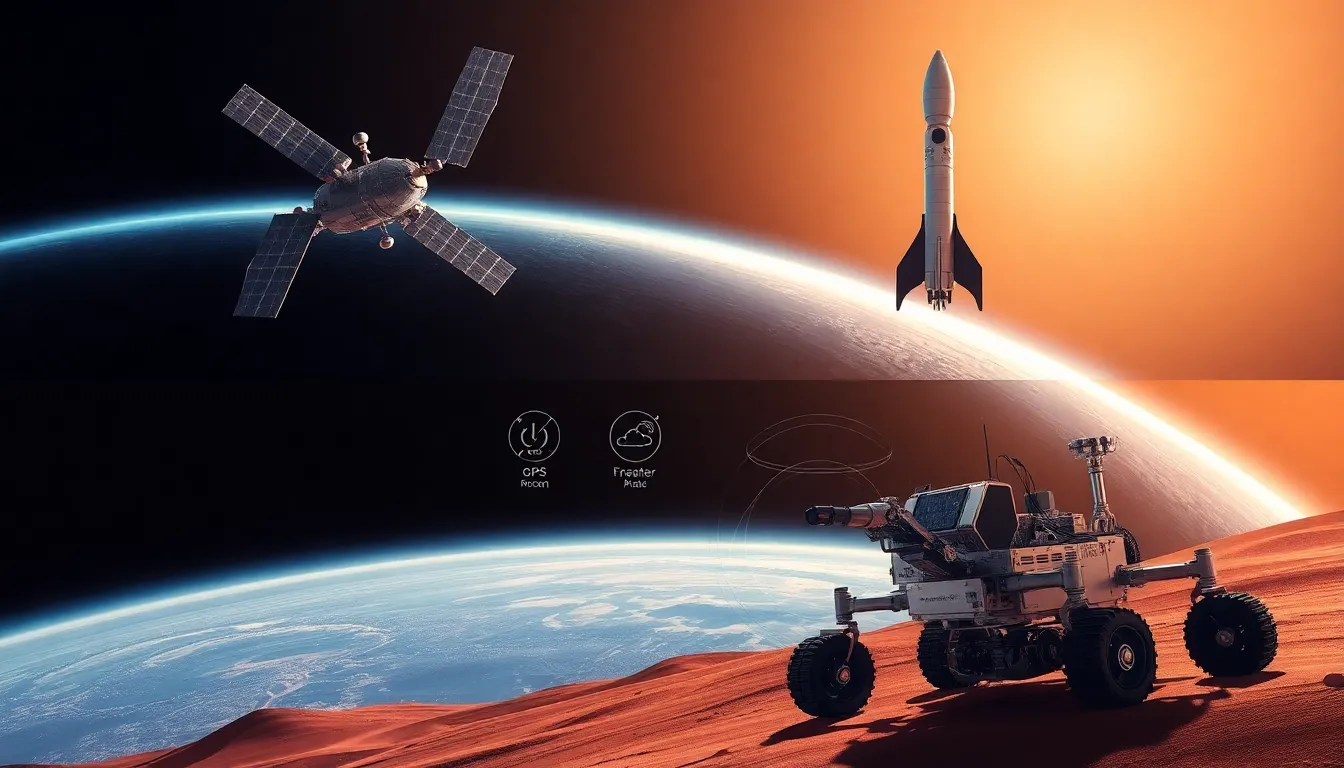
Space technology examples surround us daily, from GPS navigation to weather forecasts. These innovations began as tools for exploring the cosmos but now shape how people live, work, and communicate on Earth. Rockets carry satellites into orbit. Those satellites beam internet signals to remote villages. Spacecraft collect data about distant planets while inspiring new materials and medical devices back home.
This article explores the key space technology examples driving progress today. Readers will discover how satellites enable global communication, why spacecraft design keeps advancing, and what happens aboard space stations. The discussion also covers everyday products that trace their origins to space research. Each section highlights specific technologies and their real-world impact.
Table of Contents
ToggleKey Takeaways
- Space technology examples impact daily life through GPS navigation, weather forecasting, satellite internet, and global communication systems.
- Reusable rockets like SpaceX’s Falcon 9 have dramatically reduced launch costs from over $50,000 to under $3,000 per kilogram.
- Earth observation satellites save thousands of lives annually by enabling accurate weather forecasting and disaster warnings.
- The International Space Station recycles about 90% of its water and serves as a laboratory for microgravity research.
- NASA spin-off technologies have produced everyday products including memory foam, infrared thermometers, scratch-resistant lenses, and improved medical imaging.
- Satellite imagery and GPS-guided equipment help farmers practice precision agriculture, reducing waste and increasing crop yields.
Satellites and Communication Systems
Satellites represent some of the most visible space technology examples in modern life. These orbiting devices handle tasks ranging from broadcasting television signals to tracking hurricanes across oceans.
Communication Satellites
Communication satellites sit in geostationary orbit about 35,786 kilometers above Earth. They relay phone calls, internet data, and broadcast signals across continents. Companies like SpaceX and OneWeb are deploying constellations of smaller satellites in low Earth orbit to deliver high-speed internet to underserved areas. Starlink, for instance, had launched over 5,000 satellites by late 2023.
These systems reduce latency compared to traditional geostationary satellites. Users in rural Alaska or the Australian outback can now access broadband speeds that rival urban connections.
Earth Observation Satellites
Earth observation satellites capture images and gather data about the planet’s surface, atmosphere, and oceans. NASA’s Landsat program has provided continuous imagery since 1972. This data helps farmers monitor crop health, governments track deforestation, and scientists study climate patterns.
Weather satellites like NOAA’s GOES series deliver real-time storm tracking. Meteorologists use this information to issue tornado warnings and hurricane evacuation orders. These space technology examples save thousands of lives each year through improved forecasting accuracy.
Navigation Satellites
The Global Positioning System (GPS) relies on a constellation of at least 24 satellites. These devices transmit precise timing signals that receivers on Earth use to calculate location. Beyond smartphone maps, GPS supports aviation, shipping, agriculture, and emergency response. The European Galileo system and China’s BeiDou offer similar capabilities with global coverage.
Space Exploration Vehicles
Space exploration vehicles push the boundaries of engineering. These machines travel millions of kilometers, survive extreme temperatures, and operate in environments where no human could survive unprotected.
Rockets and Launch Systems
Rockets remain the only way to leave Earth’s atmosphere. Traditional expendable rockets like the Atlas V and Ariane 5 have launched hundreds of payloads. But, reusable rockets changed the economics of spaceflight. SpaceX’s Falcon 9 booster can land itself after launch and fly again within weeks. This innovation cut launch costs dramatically, from over $50,000 per kilogram to under $3,000 in some cases.
NASA’s Space Launch System (SLS) represents the most powerful rocket ever built. It supports the Artemis program’s goal of returning humans to the Moon. Meanwhile, SpaceX continues testing Starship, designed to carry both crew and cargo to Mars.
Rovers and Landers
Robotic explorers extend human reach across the solar system. NASA’s Perseverance rover landed on Mars in February 2021. It collects rock samples for eventual return to Earth and carries Ingenuity, the first helicopter to fly on another planet. These space technology examples demonstrate sophisticated autonomous navigation and scientific instrumentation.
China’s Chang’e program successfully landed rovers on the Moon’s far side, a first in space exploration. India’s Chandrayaan-3 achieved a soft landing near the lunar south pole in August 2023, making India the fourth country to land on the Moon.
Crewed Spacecraft
The Crew Dragon capsule from SpaceX now regularly transports astronauts to the International Space Station. Boeing’s Starliner completed its first crewed test flight in 2024. These vehicles provide redundant access to orbit, reducing dependence on any single system. China operates its own Shenzhou spacecraft, which ferries taikonauts to the Tiangong space station.
Space Station Technologies
Space stations serve as orbiting laboratories where crews conduct experiments impossible on Earth. They also test technologies needed for longer missions to the Moon and Mars.
The International Space Station
The International Space Station (ISS) has hosted continuous human presence since November 2000. This 420,000-kilogram structure orbits 400 kilometers above Earth. Astronauts conduct research in microgravity, studying everything from protein crystal growth to the behavior of flames without gravity.
The ISS demonstrates international cooperation. NASA, Roscosmos, ESA, JAXA, and CSA all contributed modules and equipment. Solar arrays spanning over 2,500 square meters power the station’s systems and experiments.
Life Support Systems
Advanced life support represents critical space technology examples for long-duration missions. The ISS recycles about 90% of its water, including moisture from crew breath and sweat. Carbon dioxide scrubbers remove exhaled gas, and oxygen generators split water molecules to replenish breathable air.
These closed-loop systems reduce the mass that must be launched from Earth. Future lunar and Martian habitats will require even more efficient recycling to sustain crews for months or years.
China’s Tiangong Station
China completed its Tiangong space station in 2022. This three-module structure hosts regular crew rotations and scientific experiments. Tiangong represents China’s growing capabilities in human spaceflight and orbital construction. The station plans to expand with additional modules in coming years.
Everyday Applications Derived From Space Tech
Space technology examples extend far beyond rockets and satellites. Research conducted for space missions often produces spin-off technologies that improve daily life on Earth.
Medical Innovations
NASA-funded research contributed to the development of infrared ear thermometers. These devices use sensors originally designed to measure the temperature of distant stars. Digital imaging technology from the Hubble Space Telescope improved mammography and early cancer detection.
Artificial heart pumps borrowed from fuel pump designs used in Space Shuttle engines. Portable ultrasound machines developed for astronaut health monitoring now serve patients in ambulances and remote clinics.
Consumer Products
Memory foam originated from NASA research on crash protection for aircraft seats. This material now fills mattresses, pillows, and helmet liners worldwide. Scratch-resistant lenses use coatings developed to protect spacecraft equipment from debris.
Water purification systems on the ISS inspired filtration technology used in developing countries. These filters remove bacteria and contaminants without electricity or complex infrastructure. Cordless power tools emerged from technology created for Apollo astronauts to drill lunar samples.
Agricultural Technology
Satellite imagery helps farmers practice precision agriculture. They can identify which sections of a field need more water or fertilizer. GPS-guided tractors plant seeds in optimal patterns, reducing waste and increasing yields.
NASA research on growing plants in space led to LED lighting systems used in vertical farms. These indoor facilities produce fresh vegetables year-round, regardless of weather or season. Space technology examples like these address food security challenges as populations grow.

