

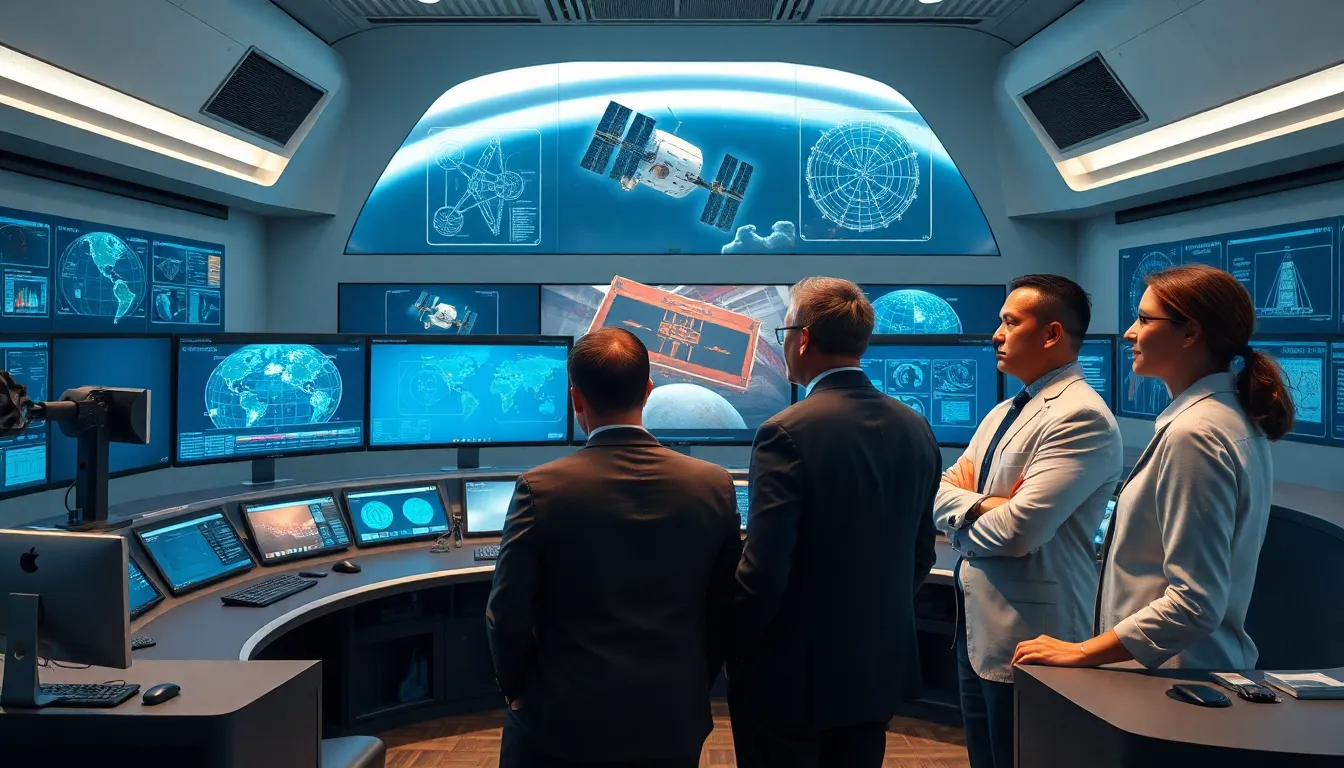
Space technology tools form the backbone of every mission beyond Earth’s atmosphere. From satellites orbiting our planet to rovers exploring Mars, these tools make exploration possible. Engineers and scientists rely on specialized equipment to gather data, maintain communication, and keep astronauts alive in harsh environments.
The space industry has evolved dramatically since the first satellite launch in 1957. Today’s space technology tools combine advanced materials, artificial intelligence, and precision engineering. They serve government agencies like NASA and ESA, as well as private companies such as SpaceX and Blue Origin. This article explores the essential categories of space technology tools and their role in modern exploration.
Table of Contents
ToggleKey Takeaways
- Space technology tools encompass propulsion systems, observation equipment, power generation, and thermal control—all working together to enable missions beyond Earth.
- Communication systems like the Deep Space Network and emerging laser technology are critical for transmitting data across billions of kilometers.
- Robotic tools such as planetary rovers and autonomous drones allow exploration of environments too dangerous or distant for humans.
- Life support systems recycle up to 90% of water and manage atmosphere, temperature, and radiation to keep astronauts alive in space.
- Future space technology tools will leverage nuclear propulsion, AI-driven autonomy, and in-space manufacturing to support ambitious missions to Mars and beyond.
- Mega-constellations of small satellites are transforming global communication and Earth observation capabilities.
Key Categories of Space Technology Tools
Space technology tools fall into several distinct categories, each serving specific mission requirements. Understanding these categories helps explain how space agencies and private companies accomplish their goals.
Propulsion Systems power spacecraft from Earth into orbit and beyond. Chemical rockets remain the primary launch method, but ion thrusters and solar sails offer efficient alternatives for deep-space missions. NASA’s Dawn spacecraft used ion propulsion to visit two asteroids in a single mission.
Observation and Sensing Equipment includes telescopes, spectrometers, and cameras. The James Webb Space Telescope represents the most advanced observation tool currently in operation. It captures infrared light from galaxies formed billions of years ago.
Power Generation Tools keep spacecraft operational. Solar panels dominate near-Earth missions, while radioisotope thermoelectric generators (RTGs) power probes traveling to distant planets. The Voyager spacecraft still transmit data using RTGs launched in 1977.
Thermal Control Systems protect equipment and crews from extreme temperatures. Space experiences temperature swings from -270°C in shadow to over 120°C in direct sunlight. These tools use insulation, heaters, and radiators to maintain safe operating conditions.
Each category of space technology tools works together in integrated systems. A single satellite might combine solar panels for power, cameras for observation, and antennas for communication.
Communication and Navigation Systems
Communication systems represent some of the most critical space technology tools in any mission. Without reliable data transmission, spacecraft become isolated and useless.
The Deep Space Network (DSN) forms the backbone of interplanetary communication. Three antenna complexes in California, Spain, and Australia provide continuous coverage as Earth rotates. These stations receive signals from spacecraft billions of kilometers away.
Radio Frequency Systems handle most space communication. S-band and X-band frequencies work well for near-Earth missions. Ka-band offers higher data rates for missions requiring large data transfers, like Earth observation satellites.
Laser Communication represents the next generation of space technology tools for data transmission. NASA’s Laser Communications Relay Demonstration achieved data rates 10 to 100 times faster than traditional radio systems. This technology will support future human missions to Mars.
Navigation tools help spacecraft determine their position and trajectory. GPS satellites provide location data for Earth-orbiting missions. Deep-space probes rely on different methods:
- Star Trackers photograph star patterns to determine spacecraft orientation
- Doppler Ranging measures velocity by tracking signal frequency changes
- Optical Navigation uses onboard cameras to identify celestial bodies
These space technology tools work in combination. The Perseverance rover used terrain-relative navigation to land within 40 meters of its target location on Mars. That precision required cameras, computers, and communication systems operating together.
Robotics and Autonomous Equipment
Robotics has transformed what space technology tools can accomplish. Machines explore environments too dangerous or distant for human crews.
Planetary Rovers represent highly visible robotic tools. NASA’s Curiosity and Perseverance rovers have explored Mars for years. They carry drills, spectrometers, and cameras to analyze rock samples. The rovers operate semi-autonomously, making local navigation decisions while receiving strategic commands from Earth.
Robotic Arms perform precise tasks in space. The International Space Station’s Canadarm2 moves cargo and assists astronauts during spacewalks. This 17-meter arm can handle payloads up to 116,000 kilograms with millimeter precision.
Autonomous Drones expand exploration capabilities. NASA’s Ingenuity helicopter completed over 70 flights on Mars, scouting terrain for Perseverance. Future missions may deploy similar aerial space technology tools on Titan, Saturn’s moon with a thick atmosphere.
Artificial intelligence improves robotic performance. Modern space technology tools use machine learning for:
- Hazard detection and avoidance
- Scientific target identification
- Resource management and fault recovery
- Image analysis and data compression
Satellite Servicing Robots represent an emerging category. These tools repair and refuel satellites in orbit, extending mission lifetimes. Northrop Grumman’s Mission Extension Vehicle docked with a commercial satellite in 2020 and provided station-keeping services.
The autonomy built into these space technology tools reduces reliance on ground control. Light-speed delays make real-time control impossible for distant missions. A signal takes over 20 minutes to reach Mars, so rovers must handle immediate decisions independently.
Life Support and Environmental Control Tools
Keeping humans alive in space requires specialized life support tools. These systems recreate Earth conditions inside spacecraft and habitats.
Atmospheric Management Systems control oxygen levels and remove carbon dioxide. The ISS uses the Oxygen Generation System to split water molecules through electrolysis. The Carbon Dioxide Removal Assembly scrubs CO2 from cabin air using chemical beds.
Water Recovery Systems recycle nearly every drop. The ISS recovers about 90% of water from humidity, sweat, and even urine. These space technology tools reduce the mass that must be launched from Earth. Water weighs 1 kilogram per liter, expensive to lift into orbit.
Thermal Control maintains comfortable temperatures. Active systems pump fluid through radiators to reject heat into space. Passive systems use insulation and surface coatings. The ISS uses both methods to handle the 90-minute day-night cycle in orbit.
Radiation Protection Tools shield crews from harmful particles. Earth’s magnetic field blocks most radiation, but deep-space travelers face greater exposure. Current solutions include:
- Polyethylene shielding in crew quarters
- Storm shelters for solar particle events
- Real-time radiation monitoring systems
Food Production Systems may eventually supplement stored supplies. NASA experiments with growing lettuce and radishes on the ISS. These space technology tools could support long-duration missions to Mars where resupply is impractical.
Reliability matters enormously for life support equipment. Redundant systems and spare parts ensure continued operation if components fail. The ISS carries backup units for every critical life support function.
The Future of Space Technology Tools
Space technology tools continue advancing as agencies and companies pursue ambitious goals. Several trends will shape the next generation of equipment.
In-Space Manufacturing will produce tools and components in orbit. 3D printing already creates simple parts on the ISS. Future systems may manufacture complex electronics and even spacecraft components using materials mined from asteroids.
Nuclear Thermal Propulsion could cut Mars transit times significantly. These engines heat propellant using nuclear reactors, offering greater efficiency than chemical rockets. NASA aims to demonstrate this technology by the early 2030s.
Advanced Spacesuits will give astronauts greater mobility and longer EVA capabilities. Axiom Space and Collins Aerospace are developing suits for NASA’s Artemis lunar missions. These space technology tools feature improved joints, better thermal control, and enhanced communication systems.
Quantum Communication may eventually secure space-to-Earth data links. China’s Micius satellite demonstrated quantum key distribution in 2017. This technology could protect sensitive military and scientific communications from interception.
Artificial Intelligence will handle increasingly complex decisions. Future space technology tools may identify scientific targets, plan efficient observation schedules, and respond to anomalies without human input. This capability becomes essential as missions venture farther from Earth.
Mega-Constellations of small satellites are changing Earth observation and communication. SpaceX’s Starlink network already includes thousands of satellites. These space technology tools provide global internet coverage and generate data for agriculture, weather forecasting, and disaster response.

