

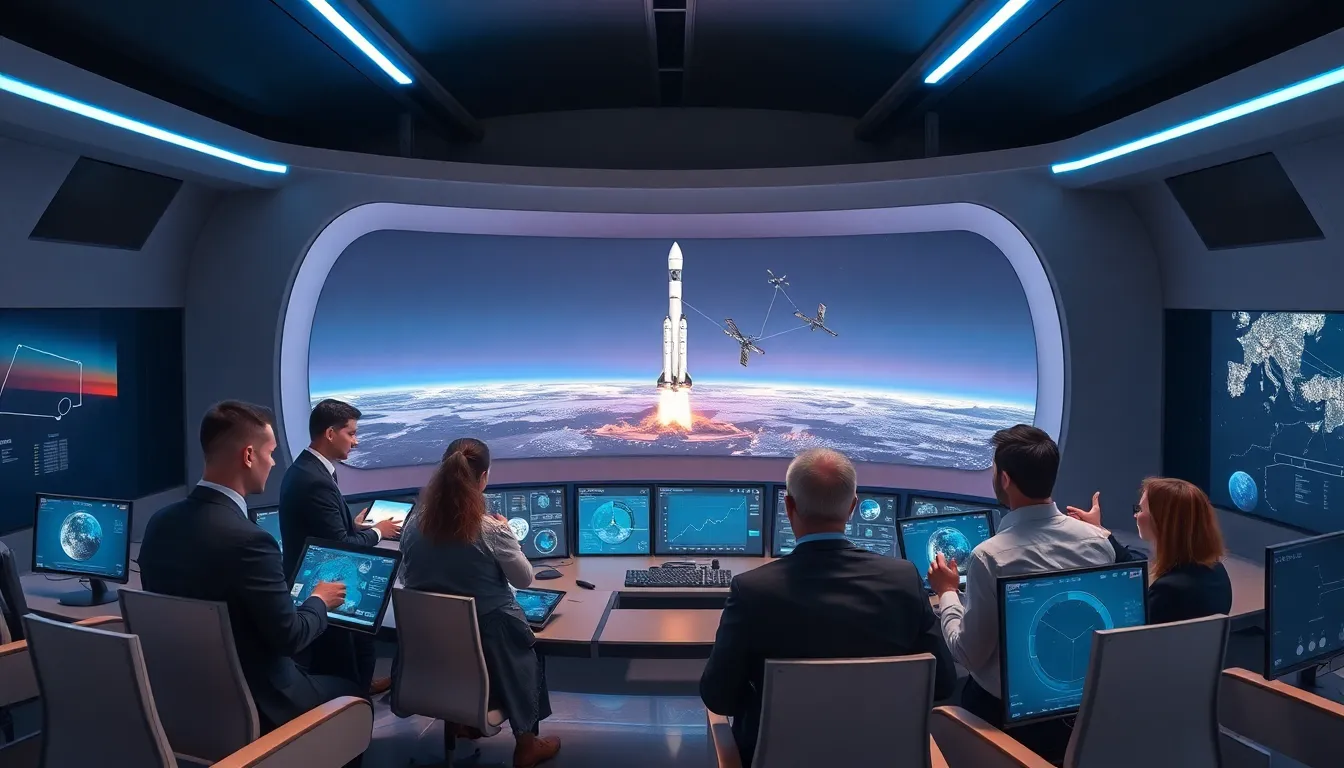
Space technology trends 2026 will reshape how humanity explores, communicates, and conducts business beyond Earth. The industry has moved past experimental phases. Companies and governments now operate with clear commercial goals and scientific ambitions. Rockets are flying more frequently. Satellites are multiplying in orbit. Private space stations are taking shape on drawing boards and in factories.
This year promises significant milestones. SpaceX, Blue Origin, and newer players will push reusable rocket technology further. Satellite constellations will expand to cover more of the planet with broadband internet. NASA’s Artemis program will continue its push toward lunar missions. And artificial intelligence will play a larger role in spacecraft operations.
Here’s what the space technology trends 2026 landscape looks like, and why it matters.
Table of Contents
ToggleKey Takeaways
- Space technology trends 2026 will be defined by reusable rockets, mega-constellations, commercial space stations, AI-driven operations, and renewed lunar exploration.
- Reusable rocket advancements from SpaceX, Blue Origin, and Rocket Lab are dramatically lowering launch costs and accelerating mission frequency.
- Satellite mega-constellations like Starlink, Project Kuiper, and China’s Guowang will expand global broadband coverage while raising concerns about space debris.
- Commercial space stations from Axiom Space, Vast, and Blue Origin’s Orbital Reef will replace the ISS, opening orbit to researchers, tourists, and private enterprise.
- AI and automation are transforming spacecraft operations—from autonomous Mars rover navigation to satellite collision avoidance and real-time Earth observation analysis.
- NASA’s Artemis program and commercial lunar landers are pushing humanity back to the Moon, with crewed surface missions targeted for 2026 and beyond.
Advancements in Reusable Rocket Technology
Reusable rockets have transformed space economics. SpaceX’s Falcon 9 has landed over 300 times since its first successful recovery in 2015. In 2026, the company aims to push Starship toward full reusability, including rapid turnaround times between flights.
Blue Origin’s New Glenn rocket entered service in late 2024 and will see expanded operations this year. The vehicle’s first stage is designed for at least 25 flights. This durability cuts launch costs significantly.
Rocket Lab is scaling up too. Their Neutron rocket targets the medium-lift market with a reusable first stage. European players like ArianeGroup are also developing next-generation vehicles with partial reusability.
Why does this matter for space technology trends 2026? Lower launch costs mean more frequent missions. Satellites reach orbit faster. Scientific payloads launch on tighter budgets. Commercial customers get better deals. The ripple effects touch every part of the industry.
Expect launch cadences to accelerate. SpaceX already launches roughly every three days. That pace could increase as Starship matures and other providers scale their operations.
The Expansion of Satellite Mega-Constellations
Satellite mega-constellations will grow substantially in 2026. Starlink leads with over 6,000 satellites currently in orbit. The network plans to add thousands more this year.
Amazon’s Project Kuiper is catching up. After launching prototype satellites in 2023, the company began commercial deployment in 2025. Amazon has approval for 3,236 satellites and intends to provide global broadband coverage.
OneWeb operates a smaller constellation of around 650 satellites focused on enterprise and government customers. The company merged with Eutelsat in 2023, creating a combined entity with both geostationary and low-Earth orbit assets.
China’s Guowang constellation represents another major space technology trends 2026 development. Plans call for approximately 13,000 satellites. Construction and deployment are ramping up.
These constellations serve multiple purposes. Broadband internet reaches remote areas. Maritime and aviation industries gain reliable connectivity. Governments secure communication channels independent of ground infrastructure.
Challenges remain. Space debris concerns are growing. Astronomers worry about light pollution affecting observations. Regulatory bodies are working on spectrum allocation and orbital coordination. But the economic momentum behind mega-constellations shows no signs of slowing.
Growth of Commercial Space Stations
The International Space Station will retire by decade’s end. NASA has contracted with private companies to build replacements. In 2026, those projects hit critical development milestones.
Axiom Space is furthest along. The company has attached its first module to the ISS and plans additional segments. Eventually, Axiom’s modules will detach and operate independently as a free-flying station.
Vast Space aims to launch Haven-1, a single-module station, as early as late 2025 or 2026. SpaceX’s Crew Dragon will ferry astronauts. The station targets both government and commercial customers.
Blue Origin leads the Orbital Reef consortium with Sierra Space. Their station design includes both rigid and inflatable modules. Development continues with a target operational date later this decade.
Northrop Grumman is building a station for NASA under the Commercial LEO Destinations program. Their design builds on experience from Cygnus cargo spacecraft.
Commercial space stations represent a fundamental shift in space technology trends 2026. Private companies will own and operate orbital facilities. NASA becomes a customer rather than an operator. This transition opens space to more users: pharmaceutical researchers, materials scientists, media companies, and tourists.
The market is real. Axiom has sold missions to private astronauts and national space agencies without their own orbital capability.
AI and Automation in Space Missions
Artificial intelligence is changing how spacecraft operate. In 2026, AI applications will expand across mission types.
Autonomous navigation already guides Mars rovers. Perseverance uses AI to select driving paths and identify interesting rocks for study. This capability reduces reliance on commands from Earth, where signal delays run 4 to 24 minutes each way.
Satellite operators use machine learning for collision avoidance. With thousands of objects in orbit, manual tracking isn’t practical. AI systems monitor trajectories and recommend maneuvers automatically.
Earth observation satellites generate massive data volumes. AI processes imagery to detect changes, classify land use, and monitor environmental conditions. Customers receive actionable insights rather than raw files.
Space technology trends 2026 include AI-powered mission planning. Software can optimize launch windows, orbital transfers, and instrument scheduling. Human operators focus on high-level decisions while algorithms handle routine calculations.
Future lunar and deep space missions will rely even more on autonomy. Communication delays make real-time control impossible. Spacecraft must make decisions independently when situations change unexpectedly.
The integration runs both ways. Space-based computing platforms may host AI workloads. Edge processing in orbit could serve customers who need low-latency analysis of satellite data.
Lunar Exploration and Artemis Program Progress
NASA’s Artemis program dominates lunar exploration headlines. Artemis II, scheduled for 2025, will send astronauts around the Moon for the first time since Apollo. Artemis III aims to land humans on the lunar surface, though the timeline has shifted to 2026 or later.
SpaceX is building the Human Landing System variant of Starship for Artemis III. The vehicle requires orbital refueling, a capability not yet demonstrated at scale. Multiple test flights will occur before crewed missions.
The Gateway lunar station is taking shape. This small outpost will orbit the Moon and serve as a staging point for surface missions. International partners including ESA, JAXA, and CSA are contributing modules.
Commercial lunar landers are part of space technology trends 2026. NASA’s CLPS program (Commercial Lunar Payload Services) contracts private companies to deliver science instruments and technology demonstrations. Intuitive Machines, Astrobotic, and Firefly Aerospace have active CLPS contracts.
Other nations have lunar ambitions. China plans crewed Moon landings by 2030. India’s Chandrayaan program continues after the successful Chandrayaan-3 landing in 2023. Japan, South Korea, and the UAE have lunar missions planned or in development.
The Moon is becoming a destination again. Water ice at the poles could support sustained human presence. Scientific questions about lunar geology and history remain unanswered. And the Moon serves as a proving ground for technologies needed on Mars.

