

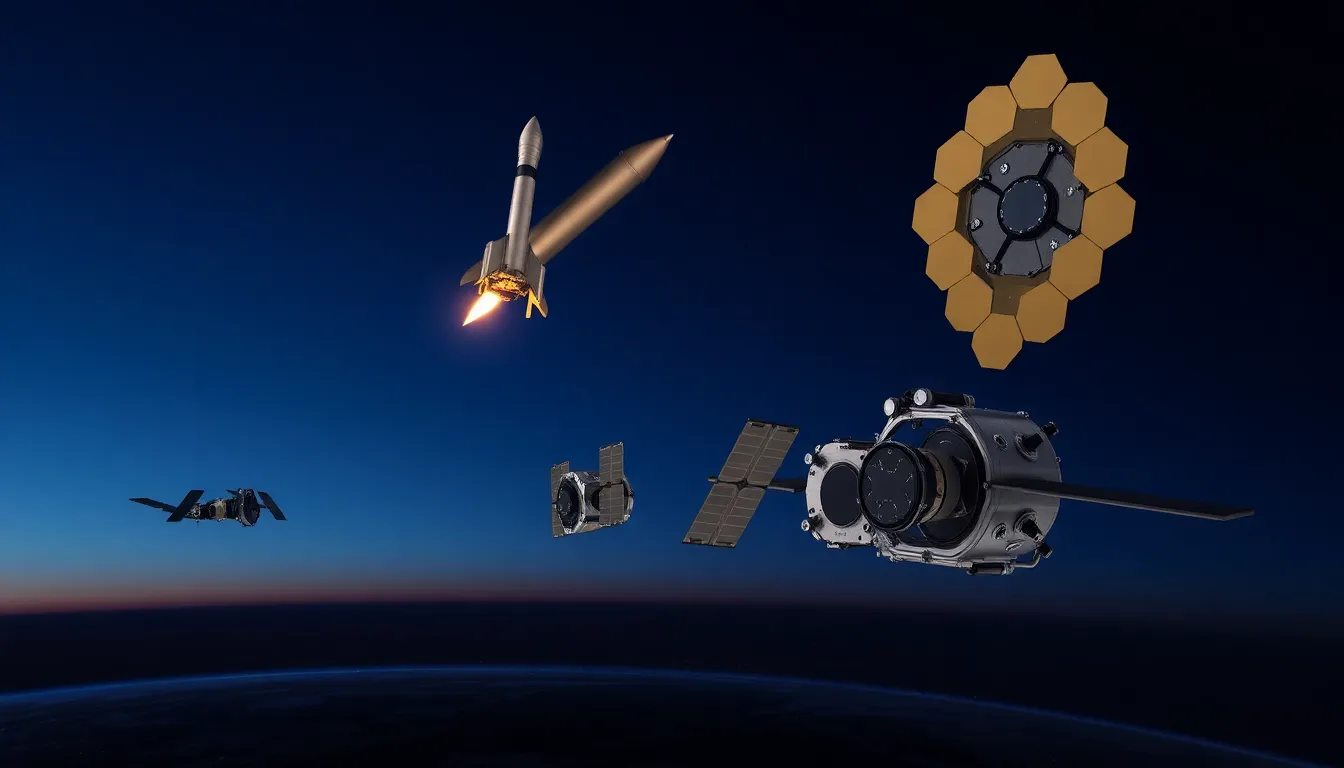
Top space technology has reshaped how humans explore the cosmos. From reusable rockets to AI-powered missions, these advancements push boundaries once thought impossible. Space agencies and private companies now work together to develop tools that cut costs, extend mission lifespans, and gather data from distant galaxies.
The space industry has entered a new era. Launch costs have dropped by over 90% in the past decade. Satellites have become smaller, smarter, and more capable. Telescopes peer deeper into the universe than ever before. This article examines the top space technology driving these changes and shaping the future of exploration.
Table of Contents
ToggleKey Takeaways
- Reusable rockets represent a breakthrough in top space technology, cutting launch costs by over 90% and making commercial space travel a realistic prospect.
- Advanced satellite technology has democratized space access, with CubeSats costing under $100,000 to build and launch while performing tasks once requiring much larger hardware.
- Space telescopes like the James Webb Space Telescope capture light from galaxies over 13 billion years old, answering fundamental questions about our cosmic origins.
- In-space manufacturing and 3D printing enable astronauts to produce tools, replacement parts, and even pharmaceutical crystals with superior quality in microgravity.
- Artificial intelligence powers autonomous spacecraft navigation and data analysis, essential for missions where communication delays make real-time control impossible.
- Top space technology continues to advance through public-private partnerships, driving innovation in propulsion, observation, and orbital construction.
Reusable Rocket Systems
Reusable rocket systems represent one of the most significant breakthroughs in top space technology. SpaceX’s Falcon 9 has landed and reflown boosters over 300 times since 2015. This achievement slashed launch costs from roughly $200 million per mission to under $70 million.
The economics are simple. Traditional rockets were single-use vehicles that burned up or crashed into the ocean after one flight. Building a new rocket for each mission made space access expensive. Reusable systems changed this equation entirely.
SpaceX’s Starship aims to push reusability further. The vehicle is designed for rapid turnaround and could eventually cost as little as $2 million per launch. Blue Origin’s New Glenn and Rocket Lab’s Neutron also feature reusable first stages.
Reusable rockets enable more frequent launches. More launches mean faster satellite deployment, quicker resupply missions to the International Space Station, and eventually affordable trips to Mars. This top space technology has made commercial space travel a realistic prospect rather than science fiction.
Advanced Satellite Technology
Satellites have evolved dramatically in recent years. Modern spacecraft are smaller, cheaper, and more capable than their predecessors. CubeSats, satellites roughly the size of a loaf of bread, now perform tasks that once required bus-sized hardware.
Starlink exemplifies this shift. SpaceX has launched over 6,000 satellites to provide global internet coverage. Each satellite weighs about 260 kilograms and costs a fraction of traditional communications satellites. The constellation demonstrates how top space technology scales to solve real-world problems.
Earth observation satellites have become essential tools. Companies like Planet Labs operate fleets that photograph every point on Earth daily. These images help farmers monitor crops, governments track deforestation, and emergency responders assess disaster damage.
Small satellite technology has also democratized space access. Universities and small nations can now afford their own satellites. A CubeSat can cost under $100,000 to build and launch. This accessibility has sparked innovation across the industry.
Advanced propulsion systems extend satellite lifespans. Electric thrusters use xenon or krypton gas to make tiny but continuous adjustments. These systems help satellites maintain their orbits for 15 years or more, compared to the 7-year average of earlier designs.
Space Telescopes and Deep Space Observation
Space telescopes have transformed our understanding of the universe. The James Webb Space Telescope (JWST), launched in December 2021, captures infrared light from galaxies that formed over 13 billion years ago. Its 6.5-meter mirror dwarfs the Hubble Space Telescope’s 2.4-meter design.
JWST operates at a temperature of minus 233 degrees Celsius. This extreme cold allows its sensors to detect faint heat signatures from distant objects. The telescope has already discovered new exoplanets, analyzed the atmospheres of worlds beyond our solar system, and captured stunning images of nebulae.
This top space technology works because space offers advantages Earth cannot match. There’s no atmosphere to blur images or block certain wavelengths of light. Telescopes can observe continuously without weather interruptions.
NASA’s Nancy Grace Roman Space Telescope, scheduled for launch in 2027, will survey wide sections of the sky. It will search for dark matter, study exoplanets, and map billions of galaxies. These instruments represent humanity’s best tools for answering fundamental questions about our origins.
In-Space Manufacturing and 3D Printing
Manufacturing in space solves problems that exist nowhere else. Microgravity enables the creation of materials impossible to produce on Earth. Fiber optic cables grown in space have fewer defects. Metal alloys form without the impurities that gravity causes.
The International Space Station hosts several 3D printers. Astronauts print tools, replacement parts, and medical supplies on demand. This capability reduces reliance on resupply missions that take months to plan and execute.
Top space technology companies see huge potential in orbital manufacturing. Varda Space Industries launched its first capsule in 2023 to manufacture pharmaceutical crystals in microgravity. These crystals form more purely in space, potentially leading to more effective medications.
3D printing also plays a role in future construction plans. NASA has tested printing structures using simulated lunar and Martian soil. Robots could one day build habitats on the Moon before astronauts arrive. This approach would reduce the weight of materials launched from Earth.
In-space assembly represents another frontier. Large structures like space stations or solar power collectors could be built entirely in orbit. Components would arrive separately and robots would assemble them. This method avoids the size limits imposed by rocket fairings.
Artificial Intelligence in Space Missions
Artificial intelligence has become essential to modern space missions. Spacecraft traveling to distant destinations cannot rely on Earth-based commands. Signals take 20 minutes to reach Mars and over 4 hours to reach Jupiter. AI enables autonomous decision-making when communication delays make real-time control impossible.
NASA’s Perseverance rover uses AI to navigate the Martian surface. Its AutoNav system analyzes terrain, identifies hazards, and plots safe paths. The rover drives faster and covers more ground than previous missions that required human approval for each movement.
AI also processes the massive amounts of data that space missions generate. The Kepler space telescope discovered over 2,600 exoplanets. Machine learning algorithms sifted through millions of light curves to identify the telltale dips that indicate orbiting planets.
Top space technology increasingly incorporates predictive AI. Systems monitor spacecraft health and predict component failures before they occur. This capability allows mission controllers to take preventive action, extending mission lifespans and preventing costly losses.
Future missions will rely even more heavily on AI. The Europa Clipper, launching in 2024, will use AI to prioritize data transmission. When the spacecraft detects something interesting, it will decide what to send back to Earth first.

